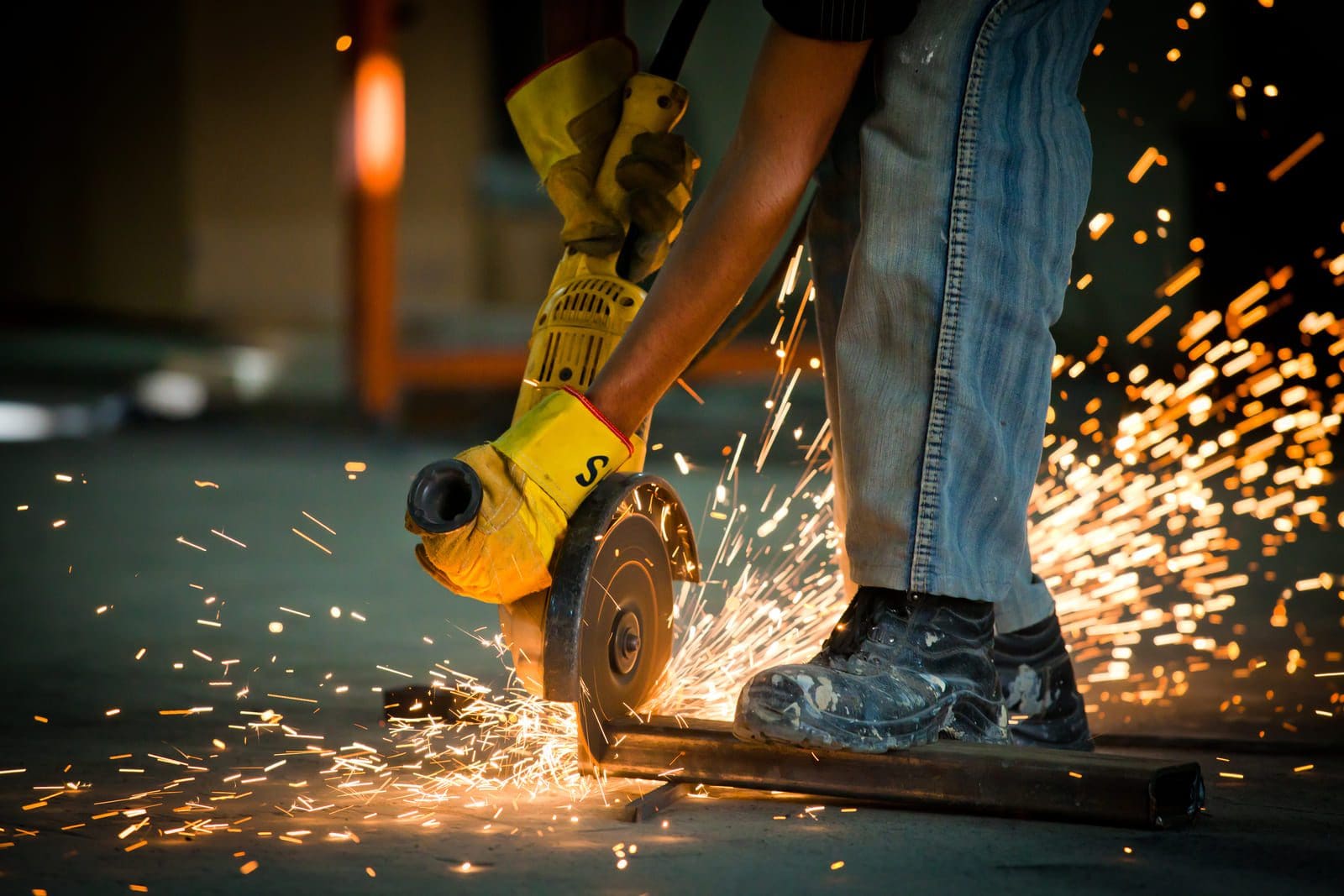
Why is it essential to master the steel cut? For many centuries before Christ, artisans from the world’s major civilizations were heating iron ore along with coal, primarily to produce weapons and tools—a process we now know as wrought iron. What they didn’t know was that, occasionally and by accident, this process—under the right conditions—resulted in steel.
They certainly had no idea that steel would be so important to the development of society, and that many centuries later, it would completely revolutionize technology and the way of life; but for this to happen, It would be essential to master the machining and cutting of steel. And it wasn't until the Industrial Revolution that the mastery of the steel as a material It ranks among the top materials used in construction and engineering in general.
Machining During the Industrial Revolution
It wasn't until the 19th century, during the Industrial Revolution, that the steel machining. Workability was very limited because cutting tools were only slightly harder than the materials they were designed to cut; they had a short service life and made the process far too expensive. Perhaps this is part of the reason why the standardization of prefabricated steel components also emerged around this time, in an effort to reduce the need for machine or cut steel.
All of this began to change when Robert Mushet conducted the first experiments with manganese and tungsten, thereby creating steel Mushet, This would result in stronger steels, capable of withstanding higher temperatures, and therefore more durable. Building on this, Frederic Taylor developed high-speed steels (HSS) in the early 20th century and later extra-high-speed steels (HSS-E), which, although they have now been largely surpassed by modern steel alloys, are still used in machining and steel cut.
Starting with World War II, experiments were also conducted with various alloys, leading to the development of even harder materials, such as cemented carbide WIDIA, the so-called CERMETS (ceramic metals), and later, in the 1970s, cubic boron nitride (CBN) and polycrystalline diamond (PCD). But at the same time, and with equal importance, significant progress was made in both the technology and the techniques of steel machining and cutting.
Steel Cutting: Computerized Numerical Control Technologies
In parallel with the machining, the following would be under development: more flexible and precise steel-cutting techniques than conventional machining methods, which eliminate the human factor from the equation; always with the goal of maximizing production efficiency. Thus, as early as the beginning of the 20th century, people were already considering cutting tools based on numerical control, that is, automation systems using programmed commands.
But nothing concrete emerged until 1942, when the exponential growth of the aviation industry demanded new levels of precision and flexibility in the production of components, leading to the introduction of numerically controlled cutting machines into mass production. Even so, at that time, they were still very expensive, took up a lot of space, and were extremely complicated to program.
The advent of microprocessors was necessary for the true revolution in numerically controlled cutting tools to take place; from that point on, they were called computer numerical control (CNC) tools (CNC). Thanks to this technological advancement, these tools became truly accessible at various levels of the metallurgical and manufacturing industries. This would greatly facilitate the adoption of technologies that are highly compatible with CNC, such as oxy-fuel cutting, plasma cutting, laser cutting, and waterjet cutting.
Oxy-fuel cutting
It is a cutting process that consists of heat the steel to 900°C using a flame produced by combustible gas, so that a stream of oxygen subsequently cuts the steel through oxidation. This technology has been in use for over a hundred years, but today it remains widely used for cutting sheet metal, low-alloy carbon steel bars, and other ferrous materials with thicknesses ranging from 3/8 inch to 12 inches.
On the other hand, this technology requires relatively little capital to implement; however, it is not as precise as other cutting techniques—typically ranging from ±0.0625 to ±0.125 inches—because the area affected by high temperatures is considerably large.
Plasma
In 1954, it was discovered that increasing the gas flow and reducing the nozzle opening produced a plasma jet, and by creating an electric arc between the nozzle and the workpiece to be cut, This plasma jet is capable of cutting completely through the thickness of the workpiece. It should be noted that this type of cutting can be performed using air, water injection, or oxygen injection.
In general, plasma provides a more concentrated heat source and much higher cutting temperatures (20,000 °C), which significantly increases the cutting speed—though this always depends on the power of the cutter. In short, it is a quite versatile cutting technology, since it allows for different levels of precision and the cutting speed is less affected by the thickness of the material than with other types of cutting.
Laser
Laser cutting was first used in 1965 to drill diamond dies, and later, in 1960, it was combined with oxygen to cut steel. This method It is based on a laser resonator, which emits a low-divergence beam of light with a very precise wavelength, and today, the vast majority are powered by a CO2 resonator.
Although the resonators used today are much more powerful than those used 50 years ago, laser cutting remains limited to material thicknesses of no more than 1.5 inches, and the capital requirements for this technology are considerably higher than for other methods. However, they have found a place in medium-sized manufacturing shops thanks to their versatility in switching cutting settings from one metal to another almost instantly.
Water jet
It is the newest technology, but at the same time quite promising; the first cut with high-pressure water jet It was developed in 1971, but at that time it was not capable of cutting through steel. With advances in pump technology that allow water to be expelled at higher pressures, and thanks to the addition of abrasive materials to the process—such as garnet or aluminum oxide—waterjet cutting has become a highly versatile and precise method.
Capable of cutting through 12 inches of material if necessary, it has become one of the preferred techniques used in manufacturing workshops, since despite its high precision and high cutting speed, it does not generate heat in the areas adjacent to the cut. Another highly appealing aspect of this system is its cost-effectiveness; in other words, the cost is directly related to the power of the water pump and, ultimately, to the specific needs it is intended to meet.
If you found this article on steel cut, in Structuralia We offer a catalog of highly specialized master's programs in every area of engineering and new technologies for anyone interested in expanding their knowledge and advancing their professional future.