#EllaEsSTEM: Breaking Down Barriers and Building the Future with Data and Technology
The STEM (Science, Technology, Engineering, and Mathematics) sector has historically been dominated by men, but more and more women are challenging stereotypes and making their mark in these disciplines. However, the gender gap remains a reality, especially when it comes to access to leadership positions and balancing work and personal life. In a world where technology is advancing by leaps and bounds, diversity in these fields is key to more inclusive and effective innovation.
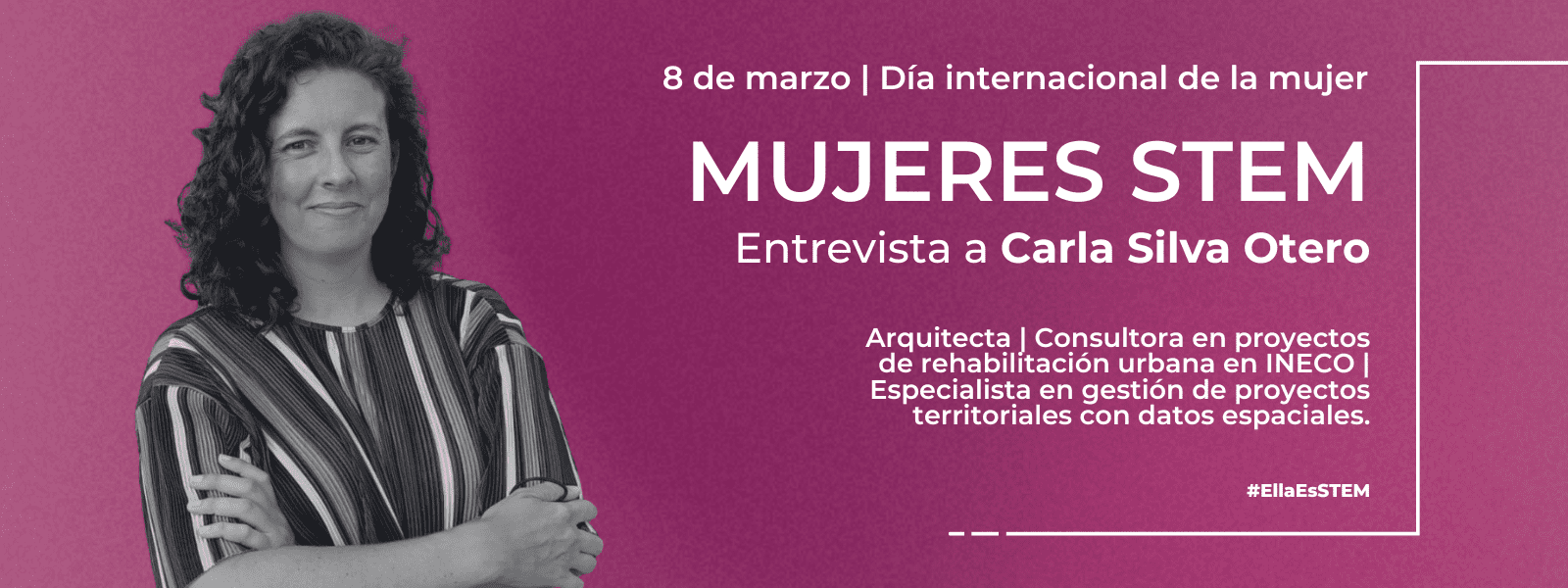
In commemoration of the International Women's Day, Structuralia launches the campaign #EllaEsSTEM, an initiative that aims to highlight influential women in the sector through interviews with alumnae and faculty members who have made a difference in the STEM field. These stories not only inspire but also shed light on the challenges, opportunities, and impact of women’s presence in the sector.
This time, we spoke with Carla Silva Otero, Architect from the Higher Technical School of Architecture in A Coruña and a master's degree in Smart and Sustainable Cities (Smart Cities) from the Complutense University of Madrid. With a career focused on territorial project management using spatial data, Carla has worked in both the public and private sectors, participating in urban renewal projects for the Panama City Mayor’s Office and in initiatives to Smart Buildings, Tourist Destinations, and the Green Transition for various organizations in Spain. He currently works at Ineco as a consultant on urban renewal projects funded by the European Union, and she is also the Director of the Master's Degree in Smart City Management on Structuralia.
In this interview, Carla shares her journey in STEM, the challenges she has faced as a woman in the field, and her vision for the future of technology and urban planning. It is a story of perseverance, curiosity, and a passion for knowledge that demonstrates that STEM is also a space for women who are leaders and change-makers.
How would you describe your journey into the STEM field?
«It's been a pretty natural path. In school, I preferred math to other subjects, so I gravitated toward the sciences. Later on, I decided to study architecture And, through a professor, I discovered Manuel Delgado's work on public space. That's when my interest in the city and its complexity began.
I began working on issues related to urban planning, which led me to discover the potential of data »and, in particular, geographic information systems (GIS). I still find the possibility of adopting more analytical perspectives to understand and act within the city fascinating. And that's where we stand."
What motivated you to choose a career in science and technology?
«I have always chosen my own path with complete freedom, without being influenced by preconceived notions about what I could or should do based on my gender, economic status, or social standing. In my family, hardly anyone had a college education, but my parents—and especially my mother—always instilled in me the importance of studying and taking advantage of every opportunity to build a better future. Driven by that motivation and free from self-imposed barriers, choosing a career in science was the most natural thing for me to do.»
What have been the main challenges you've faced in your career?
«In professional life, however, I have found differences based on gender and position. It's a topic I've thought about a lot, because the reality is that men and women have different opportunities in STEM careers and in general.
One of the biggest challenges is wages: In general, and in my opinion, men tend to rate themselves more highly and negotiate their terms with greater confidence, which results in higher salaries. But The biggest challenge, in my opinion, is motherhood and everything that entails. It’s no easy feat to navigate pregnancy, postpartum recovery, breastfeeding, and the early years of parenting while also maintaining high standards at work. That’s where the biggest gap lies: Many women give up the chance to advance in their careers to care for their families.
This is one of the reasons behind an undeniable reality: Many women do not reach senior positions not because of a lack of talent or effort, but because the system is not designed to support them in that process. »And this contributes to the lack of role models in senior positions within technology companies, universities, and other fields."
What have been the key moments in your career that have motivated you to keep going?
«One of the key moments was moving abroad in the early years of my career. That experience opened doors for me to projects I would have had a hard time accessing in Spain. That’s why I always encourage recent graduates to seek out opportunities in places where the environment is more conducive to their professional growth.»
What kind of support do you think is essential for more women to thrive in STEM?
«The hard part isn't studying a science major, but rather Showcase your work and grow professionally. It is essential to change the way we interact in the workplace so that women's voices are respected and valued equally.
It is also essential to ensure a genuine work-life balance, one that recognizes the value of care work, which continues to fall primarily on women. Motherhood, or caregiving in general, is an experience that marks a turning point in one’s professional life, and rather than viewing it as an obstacle, we should find ways to leverage the skills developed during that process to enrich our work environments.»
What are the most interesting opportunities you see in the industry for professional growth?
«The Rise of Artificial Intelligence and Analytics of large volumes of spatial data opens new doors in urban planning, sustainability, and efficient resource management. I also see a great opportunity at the intersection of technology and public policy: data is not only useful for modeling reality, but also for influence strategic decision-making at the regional and environmental levels.
Understanding this, recognizing its potential, and contributing more humanistic perspectives will be key in the future.«
How has your perception of the industry changed from when you started until now?
«When I started, we used to do mobility studies It was almost like counting cars by hand. Today, that's unthinkable. Information technology has changed everything. We now have a vast amount of data, and in many cases, we still don't quite know how to manage it.
The good news is that Access to knowledge has become vastly more widespread. In addition to college degrees, which not only provide us with knowledge but also foster critical thinking skills and a sense of community, there are now countless free courses and online resources that make it easy to stay up to date. The important thing is to stay up to date, because the industry is evolving very quickly.«
What message would you have liked to hear when you first started out in STEM?
«I would have liked to receive training in negotiation and effective communication. Knowing how to present your ideas clearly and confidently is a key skill that isn’t always taught in technical degree programs, but it makes a big difference in professional development. I would have liked someone to explain to me that it’s not just What's important is not only «doing» it, but also «communicating» it». «
What skills do you think have been key to your growth in this industry?
«Constant curiosity. To have a desire to learn and explore new tools »That's what keeps you moving forward and opens up opportunities for you in the STEM world."
How do you envision the future of women in STEM?
«There's more and more talk about the importance of soft skills, or soft skills, »And I think that's helping to create more respectful, transparent, and empathetic work environments. I wouldn't say these skills are exclusively feminine, but we're certainly moving toward a more equitable model, one in which a diversity of perspectives is truly valued."
The path for women in STEM is full of challenges, but it also offers tremendous opportunities to innovate and transform the world. Stories like that of Carla Silva Otero They remind us of the importance of perseverance, curiosity, and the fight for equity in the sector.
From Structuralia, we remain committed to raising the profile of inspiring women through the initiative #EllaEsSTEM, because we believe that diversity is key to the future of science and technology. Let's continue to inspire more women to join this revolution!