Today, one of the fastest-growing professional and operational fields worldwide is related to what is Facility Management.
The Facility Management has its origins in the the 1970s, under the format of the concierge services, primarily in building maintenance and cleaning. Later, in the the 1980s, for reduce costs, they turned to subcontractors electricity, air conditioning, and water supply. In the the 1990s, it includes property management, space planning, and office relocation.
During 2000 Business management services were gradually added and began to gain market share compared to the specific service providers, eventually becoming a very large industrial sector.
Currently, the field of facility management is one of the areas that is experiencing a real boom. In this article, we will delve into the most relevant aspects of this topic.
What Is Facility Management?
We can define FM as the comprehensive management approach that enables ensure the operation, safety, and efficiency of urban infrastructure, so that they can provide greater comfort to its users.
Facility Management. Source: dominaindustrial.com
What is the scope of facility management?
Facility Management covers the following potential areas:
1. Financial Management
Essentially, it includes investment and returns, the purchase and sale of real estate, the reconstruction of buildings, and the location of infrastructure.
2. Space Management
It encompasses both the design and use of workspaces, as well as any redesigns that may be made to adapt these spaces for future uses.
3. Operational Management
This area includes physical assets related to both maintenance and renovation management, as well as property leasing and management.
In this regard, we have the construction services which includes electricity, water, communications, transportation, fire protection, and plumbing, among others.
We also come across the building's surroundings, which relates to climate control, security, cleaning, and maintenance.
And finally, there are the construction sites including walkways, parking lots, outdoor areas, and landscaping.
4. Behavior Management
It relates to human resources in terms of user satisfaction. It has been proven that the environment affects work performance, as well as users' perceptions and engagement.
For this reason, there are specialized companies that analyze the tasks performed by work-related activities, to determine which is the optimal space, within the same areas of the company, where staff should be reassigned in order to improve their performance at work.
Organizations Related to Facility Management
Given the boom in FM over the past few decades, the International Facility Management Association (IFMA) with more than 22,000 members worldwide, spanning more than 100 countries, including Spain, where there is already a branch office.
The main objective of this association is to provide facility management professionals with the tools they need to perform their duties in this field to the fullest extent possible high level possible.
In 1993, it was recorded that EuroFM, an organization created to advance knowledge in the field of Facility Management in Europe, for which it brings together professors, researchers, and professionals specializing in this field, who conduct research in this area for its practical application.
Facility Management Functions
The main functions of facility management, regardless of the sector in which it is applied, include:
1. Improve the work environment
It aims to plan workspaces and organize workstations in accordance with environmental standards, helping companies comply with the various regulations governing occupational health and safety, in order to create safe, comfortable, and welcoming work environments for all users.
2. Organize the processes
The goal is to forecast the company’s activities through budget planning and control, contract and supply management, work order tracking, and the standardization of the organization’s workflows, with the aim of ensuring improved efficiency and increased productivity.
3. Manage the maintenance of resources
To carry out maintenance management, the Facility Manager must be familiar with the systems management such as CAFM (Computer-Aided Facility Management), CMMS (Computerized Maintenance Management System) or any software or tools to help him collect and store information, maintain an up-to-date and accurate inventory of various assets, optimize maintenance costs, and comply with safety regulations. In order to track activities that help ensure that the building and all its components remain in optimal conditions and keep their functionality over time.
4. Integrate FM with technology
Integrating technological advances with FM benefits every area under management. One example is the widespread use of the Internet of Things (IoT), through which everyday objects and devices transmit data and interact via a global network.
5. Save on costs
The productive work environment created by FM helps generate a positive impact on the company's revenue.
6. Promote sustainability
FM has a social responsibility to promote environmentally friendly and sustainable practices, such as reducing waste and optimizing energy efficiency.
7. Improve Work Performance
Facility Management must ensure the safety and well-being of all building occupants by monitoring environmental parameters and properly managing equipment, to help employees complete their daily tasks more easily and thereby improve their work performance, which in turn helps reduce employee stress.
.jpg)
What is a Facility Manager, and what types of professionals can hold this position?
The Facility Manager is the person responsible for ensure that the properties and their services operate properly, ensuring that the various systems function as intended and, in turn, that staff perform their duties in a productive, safe, and comfortable manner.
These roles are typically filled by professionals such as architects, engineers, economists, or real estate agents with expertise in organizational management and productivity resources; however, given the rapid expansion of this field, other professionals are now being included, such as graduates with a degree in Business Administration and Management (ADE), and even, company executives who hope to break into this field.
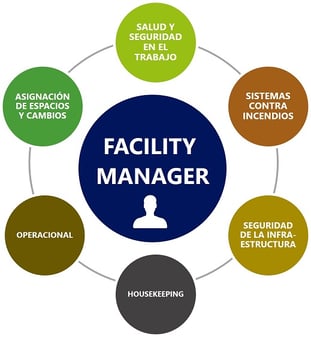 Facility Manager. Source: strategy.com.co
Where can you learn this discipline?
There are various institutions on the market that offer Master's programs and courses to learn more about what Facility Management is.
The graduate school specializing in engineering, infrastructure, energy, construction, digital transformation, and new technologies, Structuralia, offers the Master's Degree in Facility Management to provide you with training if you wish to improve your working conditions by optimizing costs and the operation of the facilities at the properties of the company you represent.
If you're thinking about your professional future, don't hesitate to check out this new field, which is booming and has great potential—even on an international level.