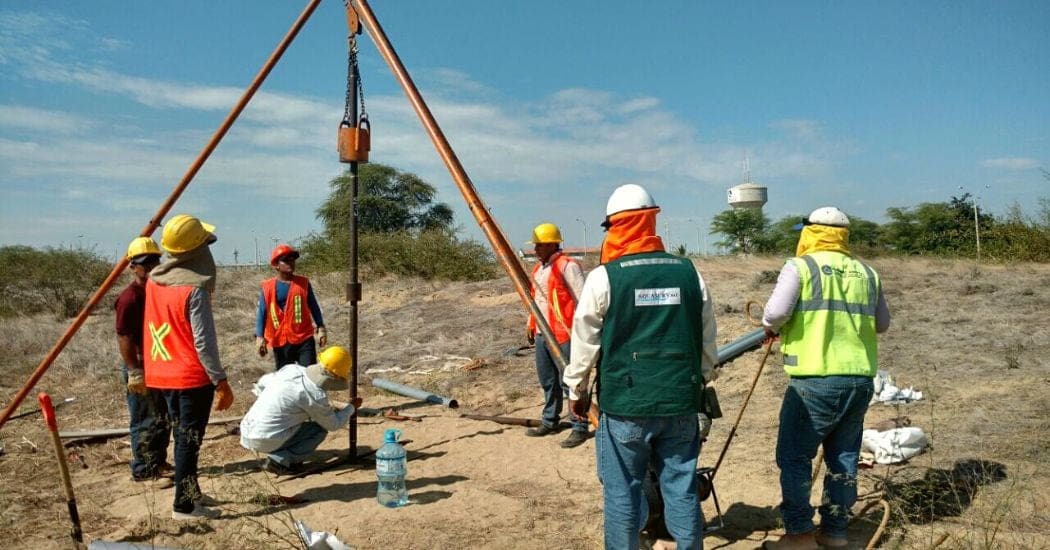
The soil particle size distribution It directly affects the type of construction to be built on it; here you'll see how and why.
The Importance of Soil Particle Size Distribution for Construction
Soils are the foundation of all the structures we build, and therefore directly affect their stability and safety, which is why we can say that soil particle size distribution is very important. To identify a soil’s particle size distribution, various types of studies are conducted, with the goal of determining several soil characteristics that define its quality particle size distribution, such as its origin, mechanical properties, the calculation of its abundance, and its curve.
What is particle size distribution?
Although we've already covered this topic in previous posts, it's worth reviewing the basics again to understand how they affect soils, and then...What impact do they have on buildings?. Particle size analysis is a basic test that provides information on the characteristics of a soil based on the size of its grains or particles; to learn more about the different types of particle size tests, we invite you to read the post at the link.
This information is illustrated graphically using the well-known particle size distribution curve, which is S-shaped and summarizes the results of soil particle size analysis in terms of the % for each grain size interval that passes through a set of sieves.
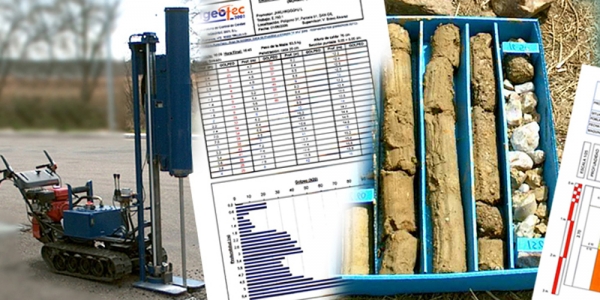 Studies on soil particle size distribution. Ingeotec 2001
How do you interpret soil particle size distribution?
Typically, particle size distribution results are expressed using values such as D10, D50, and D80 to describe the distribution of the particle sizes found, where D10 is the diameter representing 10% of the mass, D50 represents 50%, and so on. Based on this principle, the Uniformity Coefficient (Cu), which is equivalent to D60/D10, and tells us that if Cu is greater than 3, the soil we are studying is uniform.
The particle size distribution of a soil is the characteristic that most directly influences the soil permeability (the ability of a material—in this case, soil—to allow a fluid to pass through without altering its internal structure). As a simplified explanation, we can consider that a The smaller the diameter of the particles that make up the soil, the lower its permeability.; although for a deeper understanding, the Darcy's Law to determine the permeability of a soil.
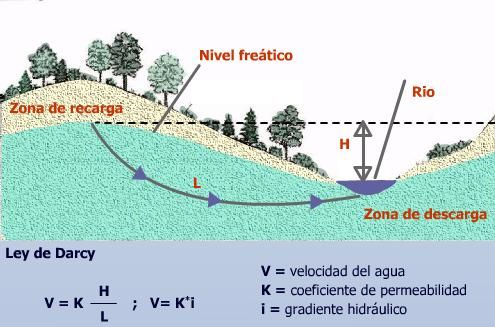 Diagram of Darcy's Law. geotechnicalstudies.info
How does particle size affect the quality of construction soil?
By analyzing soil particle size distribution and soil permeability, we are able to classify soils according to their type, thus to find out which ones are best suited for construction and so on. The more suitable the soil is, the simpler and more economical the structure needed to support the building will be. Even so, we must not forget that soils are made up of different layers, which means that if the first layer is not the most suitable for construction, At greater depths, we can find more suitable strata.
Reasons for Companies to Transform Themselves into Digital Industries
1. Sandy soils
They are characterized by being rough and dry; they contain 70 % of sand and % of clay, with the clay content below 15 %. These are soils of high permeability because their particles are widely spaced and provide excellent drainage, but they have low mechanical strength, so pose a challenge when it comes to supporting large structures.
2. Limestone soils
They are formed by the weathering of limestone, with abundant limestone and aggregate materials. They're dry, but at the same time they absorb moisture very quickly, which is why they work very well as filler for construction , The structures are mechanically very sturdy and reducing the size of the foundations necessary.
3. Silty soils
It consists of particles of gravel, clay, and fine sand, so they retain water for a long time. It is not recommended to pour a foundation in this type of soil, since it is necessary to dig too deep, fill the area with a layer of broken rock, and lay a foundation of cyclopean concrete for the walls, excessively increasing costs.
4. Clay soils
Composed of clay on a 45 % They retain a lot of water, have low porosity, and a viscous texture that prevents them from compacting well. This soil is hard when dry, but becomes viscous and soft when it comes into contact with water, which makes them dangerous for laying the foundation of any building since soil compaction can take several years.
5. Stony soil
It is the type of soil that Wanted for laying the foundation of a building, are impermeable soils that contain rock formations. They are great for working on multi-level projects, and to begin constructing the footing for any foundation; however, if this layer of soil is very shallow, it can cause difficulties during foundation construction, since Much heavier machinery is needed to carry it out.
Conclusion
The soil particle size distribution It is one of the most important parameters for determining the suitability of a site for construction. It provides key information on permeability, strength, and uniformity, which makes it possible to design safe foundations and optimize costs.
Just as in architecture there are visual techniques such as the trompe-l'œil Just as the particle size distribution in geotechnical engineering shapes our understanding of the soil and influences structural design decisions, it can also transform our perception of a building.
To gain a deeper understanding of the behavior of each type of soil and the studies that should be conducted, we invite you to explore the training program offered by the International Master's Degree in Geotechnical Engineering and Foundations.