The competition in the industrial sector, an increasingly demanding market that calls for better, more affordable products with faster delivery times, is experiencing progress and improvements in the optimization of industrial engineering projects within the new framework of the Industry 4.0.
Below, we describe some of the tools that involve these concepts.
Lean Manufacturing
This work organization tool for integrated industrial engineering projects within the framework of Industry 4.0 focuses on the productivity and process optimization to reduce production times and costs by eliminating redundant activities that do not add value to the process.
For this approach to be effective, it will be important to understand the principles to be applied, which incorporate concepts from other industrial management tools, such as identifying the problem at its source and working with processes “”pull" in which production is based on demand rather than on processes “push”, where the machine is forced to produce and, above all, to adopt a different sales strategy. It is not a modular product that is being sold, but rather a customer-tailored solution.
Ishikawa Diagram
In any situation, an engineer must analyze the causes that led to it in order to identify the root cause and thus find a solution.
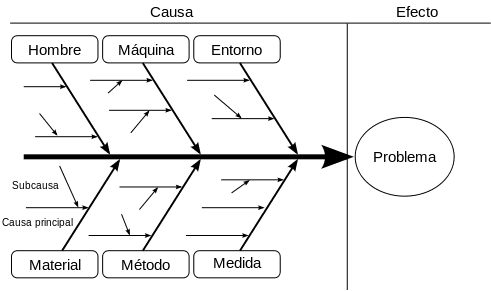
The Ishikawa diagram, also known as a cause-and-effect diagram or fishbone diagram, consists of a graphical representation system which organizes ideas using a horizontal diagram that groups the possible causes and contributing factors that may have led to the problem.
SMED
“Single-Minute Die Change”. This acronym refers to a management tool used in industrial engineering projects that simplifies the process of changing models on all types of parts-manufacturing machines, thereby reducing cycle times.
The tool is actually based on reduce inventory levels used in production, thereby reducing production times by cutting down on changeover times and internal and external machine setup times. Reducing inventory allows for better planning of batch deliveries and streamlines deliveries by reducing the need for storage.
Total Productive Maintenance (TPM)
The TPM This is a concept that originated in Japan and consists of ePreventive maintenance involving partial and periodic inspections Performed at the optimal time to prevent excessive wear and premature intervention, thereby ensuring the expected availability and reliability of operations. Maintenance is performed on equipment and facilities to ensure optimal machine performance based on two main principles: Time-Based Maintenance (MBT) and the Condition-Based Maintenance (CBM).
The 8 Disciplines (8D) Method
This tool allows you to Establish a systematic work structure for industrial engineering projects involving the various professionals who participate in the industrial process through a unified approach, which is essential for improving processes, services, or products and thereby becoming more competitive.
This methodology focuses on identifying a problem, correcting it, and implementing the necessary measures by following eight sequential steps designed to minimize the likelihood of a similar problem occurring again in the future.
The "5 Whys" Technique
This industrial management tool Seek a solution to a problem by addressing its root cause And to find it, we ask ourselves why it is so.
"Why did this happen?" That question will prompt an answer that leads to another "why," and so on, until we get to the root of the problem. That’s where the name comes from—it’s simple—but asking these questions requires trained staff who can phrase them correctly so that this process is as efficient and effective as possible.