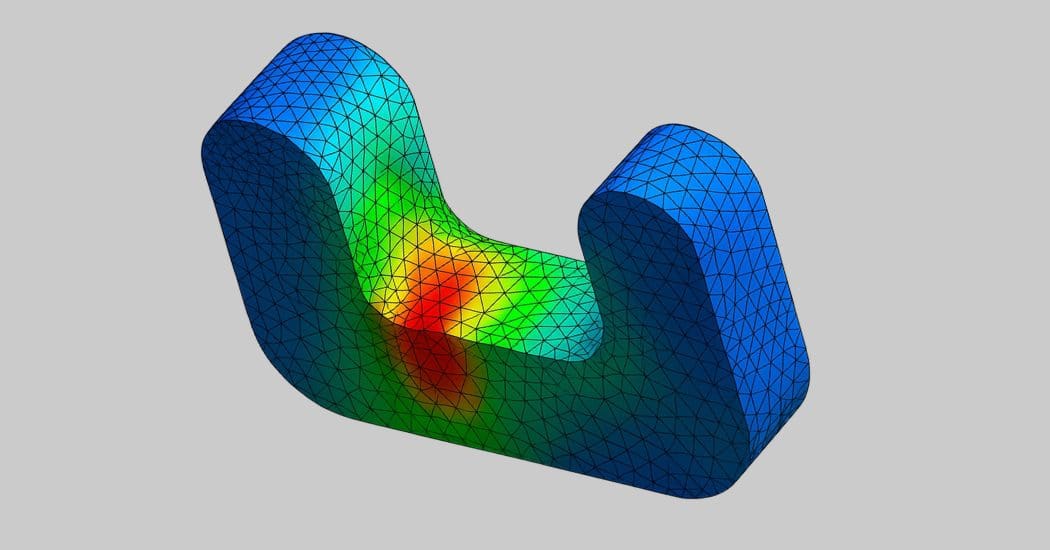
In the context of the Digital Transformation and Industry 4.0, the finite element method (FEM) by Zienkiewicz, is an essential tool for the analysis and design of complex products. This computational simulation technique makes it possible to predict how a physical object will behave under different conditions, without the need to build costly physical prototypes.
Mastery of the finite element method not only improves accuracy in design and validation processes but also provides a competitive advantage for any technical professional. Did you know that many of the Highest-Paid Engineers Do they have a strong command of finite element analysis to optimize their projects and lead technological innovation?
But what exactly does this methodology entail, and why is it so widely used in engineering? We'll explain it below.
What is the finite element method?
Imagine you have to analyze how a complex structure—such as a bridge, a chair, or even an airplane part—will behave. Doing all the mathematical calculations at once would be extremely complicated, wouldn't it? This is where the finite element method (FEM): a numerical technique that divides that object into many small, manageable parts, as if it were a jigsaw puzzle. Each of these parts is called «finite element».
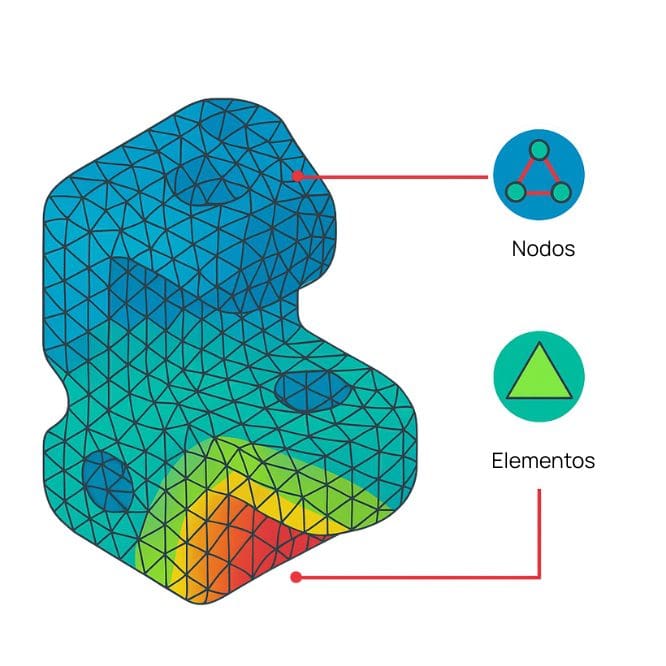
By studying each of these elements separately and then combining the information, specialized software can simulate with great precision how the entire assembly will behave in different situations: “Will it bend?”, “Will it vibrate?”, “Will it overheat?”, “Could it break?”
This method makes it possible to predict results without having to build expensive physical prototypes, which is why it has become an essential tool in fields such as automotive, aerospace, construction or the biomechanics, which also incorporates advanced technologies such as Smart Materials in Architecture.
How does a finite element program work?
Finite element programs are typically organized into three main modules, which structure the simulation process in a logical and efficient manner:
1. Preprocessor
This module is responsible for gather all the information required before running the simulation. It includes:
- Geometric modeling: The shape and dimensions of the object or system are defined.
- Mesh Generation: The model is divided into small elements (triangles, quadrilaterals, tetrahedrons, etc.).
- Definition of Materials: Physical and mechanical properties (elasticity, density, conductivity, etc.) are assigned.
- Boundary Conditions: forces, constraints, pressures, temperatures, etc., are applied.
- External loads and contacts: The points of interaction with the environment or between components are defined.
2. Processor or computer
This is the core of the program, where the numerical analysis. This is where it takes place:
- Formulation and Assembly of the system of equations that governs the model's behavior.
- Mathematical Solution of the system using numerical methods (such as the direct or iterative method).
- Calculation of Interim Results, such as nodal displacements, internal stresses, strains, velocities, or temperatures.
3. Post-processor
This module allows you to interpret and visualize the results obtained from the analysis. The most common functions are:
- Graphical display: maps of stress, strain, displacement, temperature fields, etc.
- Data Extraction: quantitative results at critical points or lines of interest.
- Verification and Validation: comparison with theoretical or experimental results, or with design limits.
- Animations: for transient or dynamic response studies.
This modular structure allows for organized work and facilitates both the development of complex models and the detailed analysis of results.
Advantages of the finite element method
The use of the finite element method It offers numerous benefits for organizations committed to innovation:
- Reduction in the number of physical prototypes, resulting in savings in resources.
- Greater accuracy in structural, thermal, and dynamic analysis.
- Optimization of design and manufacturing processes.
- Early detection of errors or weaknesses.
- Applicability to various fields of engineering and applied sciences, such as drone and anti-drone engineering or civil engineering.
Finite Element Analysis Software
There are various software solutions for the finite element method, each tailored to different industries. Some of the most widely used are:
- ANSYS: It is an extremely versatile and powerful computer-aided engineering (CAE) simulation software. Its strength lies in its ability to handle a wide range of physical phenomena and simulations across various disciplines, making it ideal for multipurpose simulations.
- Abaqus: It is a high-performance finite element analysis (FEA) software program that is particularly highly regarded in industries such as automotive, aerospace, and biomechanics. It specializes in the nonlinear analysis of materials and structures, as well as in complex contact simulations.
- SolidWorks Simulation: Integrated into CAD environments, ideal for product engineers.
- COMSOL Multiphysics: specializing in coupled physical simulations (electrical, thermal, mechanical).
All of these programs include advanced modules that facilitate post-processing, results analysis, and integration into broader digital workflows, such as those used in projects involving BIM Applied to Civil Engineering.
Conclusion
The finite element method (FEM) It has established itself as an indispensable tool for engineers and technical professionals seeking to optimize designs, reduce errors, and make decisions based on accurate simulations. In an environment where technological innovation and efficiency are key, mastering this methodology not only improves the quality of projects but also opens the door to new professional opportunities in highly specialized sectors.
Investing in MEF's educational programs means committing to a career aligned with the Engineering 4.0, where the ability to analyze, model, and predict the behavior of structures and systems makes for a highly valued technical profile. Because in today's world, Simulate before building It is no longer just an option, but a competitive advantage.
Get trained with Structuralia and prepare to lead the engineering of the future.