
The moment of inertia is the physical quantity that measures the a body's resistance to a change in its rotational motion relative to an axis of rotation. In mechanical and structural engineering, this property determines how a system responds to an applied torque and how a cross-section resists bending.
It is the rotational equivalent of mass in the case of rectilinear motion. While mass quantifies the resistance to linear acceleration, the moment of inertia quantifies the resistance to angular acceleration.
What is inertia?
The inertia It is the property of bodies to maintain their state of rest or uniform linear motion unless an external force acts upon them. This principle is formalized in Newton's First Law.
In the case of the rectilinear motion:
where:
- F is the force (N),
- m is the mass (kg),
- a is the acceleration (m·s−2).
In rotation, the equivalent is:
where:
- τ is the torque (N·m),
- I is the moment of inertia (kg·m2),
- α is the angular acceleration (rad·s−2).
The key difference is that the moment of inertia depends not only on mass, but also on its distribution with respect to the axis of rotation.
What is moment of inertia?
The moment of inertia is the sum of the products of each mass element by the square of the distance to the axis of rotation:
In its entirety:
where:
- r is the distance perpendicular to the axis (m),
- dm is the differential mass (kg).
The term square of the distance implies that small variations in the position of the mass produce significant increases in the angular momentum.
Properties of the Moment of Inertia
- It depends on the axis of rotation: Changing the axis modifies its value.
- It's addictive: It can be calculated as the sum of the partial products of several elements.
- It depends on the geometry: Shape is just as important as total mass.
- It's rock climbing relative to a given axis.
In structures, the equivalent concept is the area inertia (second moment of area), with units of m4, used to evaluate flexural stiffness.
You may also be interested in reading: Structural Design for Earthquake Resistance: The Science Behind Safe Buildings
Calculating the Moment of Inertia: Equations
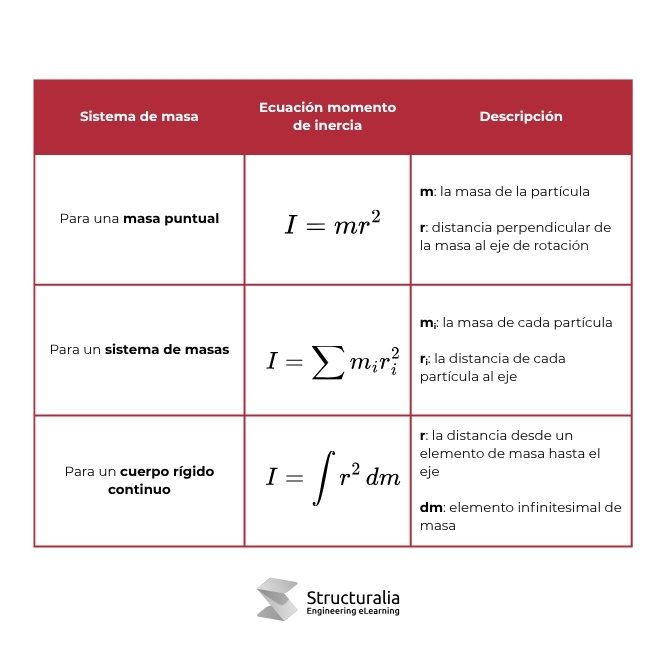
The calculation of the moment of inertia (I) It is based on equations that vary depending on the type of mass distribution (discrete or continuous) and the object's geometry. Let's take a look at these equations!
1. General Equations
2. Steiner's Theorem (parallel axes)
In most cases, we don't rotate objects around their center of mass. For example: when we open a door, the rotation doesn't occur at the center, but at the hinges, which are at one end. This leads us to ask an important question:
“What happens to the moment of inertia when the axis of rotation does not pass through the body’s center of mass?”
We find the answer in the Steiner's Theorem, also known as parallel axes theorem. Which establishes the following premise:
If we move the axis of rotation to a position parallel to the axis passing through the center of mass, the new moment of inertia will be greater than the minimum possible (that of the center of mass).
Mathematically, this can be expressed as:
where:
- Ic is the angle relative to the centerline,
- m is the total mass (kg),
- d is the distance between parallel axes (m).
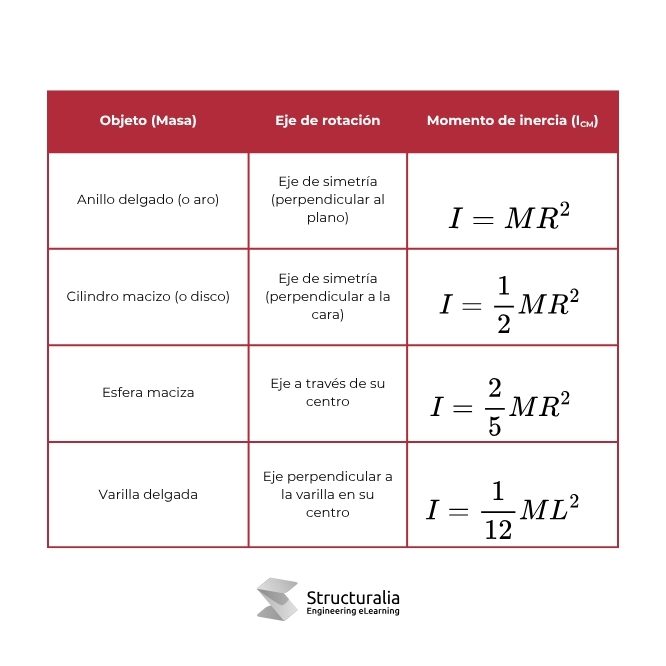
3. Equations for Common Geometric Shapes (Axis Through the Center of Mass)
When we study the moment of inertia, it is important to remember that not all objects are the same. Some have complex shapes or irregular mass distributions, but others (such as cylinders, spheres, or rods) are rigid, homogeneous bodies y of regular geometry.
In these cases, the calculation of the moment of inertia about the center of mass is carried out through standard formulas that have already been derived using integral calculus and are applied directly based on the shape of the object. Check out these examples!
Analyze the moment of inertia
Analyze the moment of inertia This involves interpreting how its value affects the mechanical behavior of a system. The analysis varies depending on whether it involves rotational motion or of structural deflection.
1) In rotational motion (dynamics)
In dynamic systems, the moment of inertia determines the resistance to angular acceleration according to:
Solving:
If the applied torque is constant:
- Greater I → lower angular acceleration
- Lower I → higher angular acceleration
This means that a body with high rotational inertia changes its angular velocity more slowly. For this reason, flywheels are designed with mass distributed away from the axis of rotation.
2) In structural engineering (area moment of inertia)
In structural engineering, the analysis focuses on the second penalty kick, which determines the bending stiffness. The deflection of a beam is inversely proportional to I:
- Greater I → less deformation
- Lower I → greater deformation
For a rectangular cross-section:
The term h³ Evidence shows that increasing the height significantly increases stiffness. For this reason, structural profiles concentrate material away from the neutral axis to maximize the moment of inertia without proportionally increasing the weight.
Technical Interpretation
| Scope | What Determines I | Effect of Increasing I |
|---|---|---|
| Rotational Dynamics | Reluctance to speed up | Greater angular stability |
| Structural Deflection | Cross-sectional stiffness | Less deformation |
In both cases, the determining factor is not just the mass or the total area, but rather its distribution relative to the axis of rotation or neutral axis.
Common Conceptual Errors
- Confusing mass with moment of inertia: Mass measures the amount of matter; momentum also depends on shape.
- Forget the distance squared: It is the factor that has the greatest influence on torsional stiffness.
- Misusing Steiner's theorem: It applies only between parallel axes.
- Ignore units: The result must always be expressed in kg·m².
- Failing to consider the main themes: With irregular shapes, choosing the wrong axis completely alters the results.
In conclusion, the moment of inertia is a fundamental measure of the mass distribution which defines the rotational response of a body. Understanding and correctly applying these principles are essential for the safe and efficient design of structures and mechanical systems.