A reinforced earth wall It is a linear retaining structure composed of earthen materials reinforced with metal mesh, typically metal strips or bars arranged in horizontal planes to improve its mechanical properties.
A reinforced earth wall is a linear retaining structure composed of earthen materials to which reinforcement—usually metal strips or bars arranged in horizontal planes—is applied in order to improve its mechanical properties.
It is used as a cost-effective and versatile solution for reinforcing soil masses on horizontal platforms, slopes, and road embankments where there is limited space for constructing earthworks or bridge abutments and artificial slopes, as it increases their stability.
In this post, we will describe the advantages of this system, including its functional components, their characteristics, and the roles they play.
Components of a reinforced earth wall
The basic structure of a reinforced earth wall consists of a granular fill, stabilized by horizontal reinforcements, a vertical wall on its exposed side that serves as a retaining structure, and a drainage system.
Granular Filler
The volume of granular material provides compressive strength by acting as a gravity wall; the weight of the material resists external compressive loads by generating a frictional response.
It is essential to perform a Good grading and material selection, avoiding the presence of fine clay or silt particles that could affect the permeability and creep of the embankment. It is also important to note the significance of the internal friction angle of the backfill, which is directly related to cohesive strength and tensile strength; an angle of at least 22° is recommended for saturated soils and 25° between soil and reinforcement under the same conditions.
Horizontal reinforcements
The use of horizontal reinforcements provides shear and tensile strength to the mass, improving its cohesion and stability, despite proper compaction. The spacing between the layers will depend on the stability analysis and typically ranges from 20 to 30 cm.
The most commonly used system consists of metal strips, galvanized to prevent corrosion, but the problems of degradation and rising maintenance costs make it advisable in many cases to seek alternatives such as geotextile sheets or geogrids, made of petroleum-derived polymers, or geocomposites consisting of two or more materials.
Facing
This is the visible part of the structure. It consists of precast concrete slabs or shotcrete, as well as concrete chips, to which the horizontal reinforcements are anchored.
This is a linear element that prevents soil from sliding down and limits the longitudinal deformation of the rock mass. It can be reinforced with steel mesh when the load is very high.
When sizing the structure, it is important to keep in mind that very high walls can cause unacceptable settlement; therefore, it is recommended to install vertical spacers equipped with joint covers. In addition, a depth of foundation enough to prevent ground subsidence and potential siphoning caused by water flow.
Drainage
Rain or melting snow can cause water to flow through the structure's fill, reducing its cohesion and potentially causing it to collapse, which is why it is necessary to good drainage system.
At the start of construction, a drainage pipe must be installed at the rear and covered with large-diameter gravel. Subsequently, as the backfill material is added, channels will be created to divert water using intermediate layers sloped toward the rear of the embankment to direct the water toward the filter, or, if required by the structure’s design, through the use of layers of drainage material.
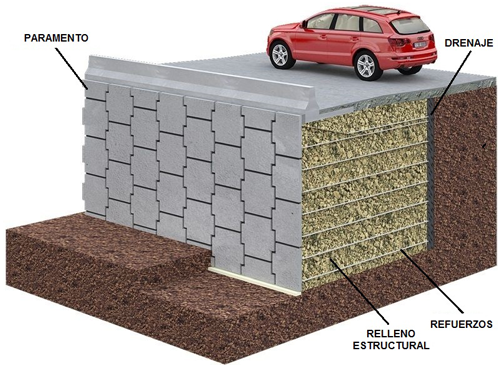
Reinforced Earth Wall®. Source: http://www.tierra-armada.cl/sistema.html
Advantages of a reinforced earth wall
One of the greatest advantages of reinforced earth walls is that the cost-effectiveness of its construction and the ease with which it can be adapted to the terrain due to the use of local materials. It does not require the use of heavy machinery and, therefore, does not require a large workspace or incur the transportation costs associated with large volumes of external materials, provided they are available nearby.
Another advantage of this material is the ease of construction, repair, and demolition. Furthermore, since it is not a rigid structure, it can accommodate seating and blends well into the landscape, with its surface being replanted.
Similarly, even though it is a simple structure, a preliminary study is necessary: stratigraphy, water table, presence of harmful substances, and the geometric and strength properties of the soil.