The parts of a electric service connection They are necessary for our day-to-day activities and can often go unnoticed.
What are the components of an electrical service connection?
The electric service connections They are the backbone of any electrical installation. Thanks to them, electricity flows from the distribution grid to our homes, offices, and factories. Although they go unnoticed in our daily lives, understanding their components is essential to appreciating their importance to the safety and efficiency of the power supply.
In a world that is increasingly dependent on energy and technological devices, understanding how these systems work is just as important as understanding other key aspects of engineering, such as Types of Connecting Rods, Their Function, and Applications, which are essential for transmitting motion in machinery.
What is an electrical service connection?
In simple terms, an electrical service connection is the primary connection between the power grid and a building, whether it's a home, a factory, or a business. It consists of several essential components that ensure the safe and efficient transmission of electricity. Among The parts of an electrical service connection These include the input wiring, the energy meter, and the protective devices. Each of these components serves a crucial role in security and the performance of the power grid, but before we go into detail, let's take a look at theTypes of Service Connections that exist...
Types of Electrical Service Connections
There are 4 types of utility connections, each with unique characteristics that are suited to different environments and energy demands. Below is an overview of the the most common types of electrical service connections, illustrating its importance in the efficient and safe distribution of electricity.
1. Low-Voltage Service Connections:
These connections are the most common in homes and small businesses. They operate with voltages up to 1,000 V and are designed for low-power applications. The simplicity and low cost of low-voltage service connections make them the ideal choice for residential and small-scale commercial settings.
2. Medium-Voltage Service Connections:
Designed to meet higher-demand needs, medium-voltage service connections operate at voltages ranging from 1,000 V to several thousand. They are commonly found in industrial facilities, larger commercial buildings, and areas where a more robust and powerful power supply is required.
3. Overhead Service Connections:
These service connections are visible in many urban and rural areas, where electrical cables are strung on poles or elevated structures. Despite their exposure to the elements, overhead service connections are relatively easy to maintain and repair, making them a practical choice in many situations.
4. Underground Service Connections:
For a more aesthetically pleasing and safer solution, underground service connections hide the wiring beneath the ground. This type of service connection minimizes the risk of outages caused by adverse weather conditions and provides a cleaner look in urban areas. Although the initial installation may be more expensive, its durability and appearance often justify the investment.
Components of an Electrical Service Connection
To fully understand how an electrical service connection works and how it plays a vital role in power distribution, it is essential to break down its main components. Here, we will explore each of the parts of an electrical service connection (from the electrical transformer to the fuse switch).
1. Electrical Transformer
The first stage in the electrical supply chain is the transformer. Its function is to convert the voltage from the distribution network to a level suitable for consumption within the building. This essential component ensures that the power flowing through the service connection is in a usable and safe form.
2. Mufa
The junction box, also known as a connection box, is the point where the distribution network wiring connects to the building's internal wiring. It provides a safe and secure connection, ensuring that power flows without interruption and minimizing electrical hazards.
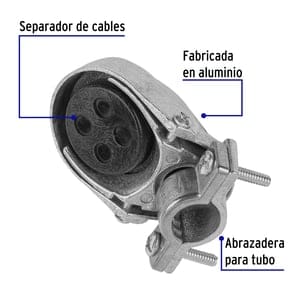
Example of a Mufa as part of an electrical service connection. Truper.com
3. Conduit Pipe
A crucial component for the physical protection of wiring is conduit. This sturdy and durable conduit houses the cables and protects them from potential mechanical and environmental damage. It also facilitates the orderly routing of cables from the junction box to the interior of the building.
4. Wiring
Electrical cables are the veins and arteries of the service connection. They carry electricity from the power grid to the points of use within the building. The quality and proper sizing of the wiring are crucial to ensuring the system’s efficiency and safety.
5. Physical Earth
To prevent dangerous electric shocks and minimize the risk of power surges, a physical ground connection is established. This provides a safe path for unwanted electrical current, diverting it to the ground and protecting people and equipment.
6. Thermomagnetic Switch
This protective device is essential for safeguarding the service connection and the building against electrical overloads and short circuits. It acts as a vigilant guardian, cutting off the electrical current in the event of anomalies to prevent further damage.
7. Fuse Switch
Similar to a thermal-magnetic circuit breaker, a fuse also provides protection against overloads. When the current exceeds safe limits, the fuse blows, breaking the circuit and preventing damage to the system and its components.
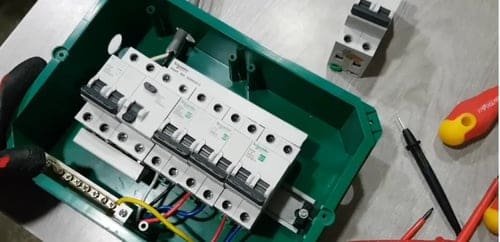
Box containing thermomagnetic circuit breakers: one of the components of an electrical service connection. Fcmsolutionsperu.com
For professionals in the industry, understanding The parts of an electrical service connection It is essential, but it is also important for all of us to be familiar with these key elements in our daily lives, both personally and professionally. From the transformer to the switches are essential for proper operation in our homes, offices, and factories.