Can seemingly solid ground turn into a fluid mass in a matter of seconds? This phenomenon, known as liquefaction, has been responsible for some of the most devastating collapses in the history of civil engineering. From the 1964 Niigata earthquake in Japan to the 2011 Christchurch earthquake in New Zealand, liquefaction has tested the limits of structural design and urban planning.
In the field of civil and geotechnical engineering, understanding how and why this process occurs is essential to ensuring the safety of infrastructure. Liquefaction not only compromises the stability of foundations but can also cause lateral displacement, subsidence, and, in extreme cases, the total collapse of buildings and engineering structures.
What is liquefaction?
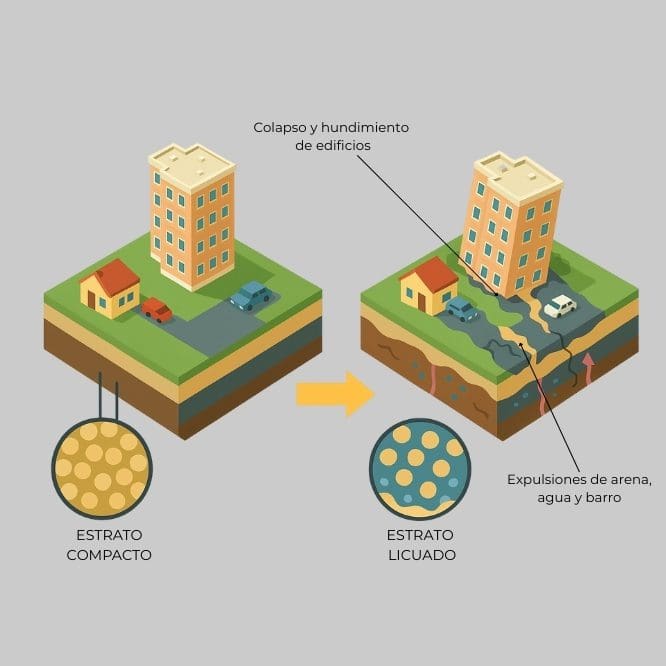
The soil liquefaction It is a process by which saturated granular soil (primarily sand saturated with water and located near the surface) loses its strength and stiffness when subjected to cyclic stresses, such as those caused by an earthquake.
Under normal conditions, soil particles are in contact with one another, and water fills the pores. However, under intense vibrations, the interstitial water pressure increases until it equals the effective pressure, causing the soil to behave like a fluid.
In simple terms, it's like shaking a glass filled with sand and water: when you shake it vigorously, the sand loses its structure and the particles begin to float, unable to support loads. In engineering, this phenomenon is particularly critical because it directly affects foundations, retaining walls, piles, and underground structures.
Factors that Contribute to Liquefaction
Not all soils or geological conditions pose the same risk. Among the most significant factors are:
- Soil Type: Non-cohesive sands and silts (a type of fine-grained soil) are the most susceptible to liquefaction.
- Soil density: Loose soils are much more vulnerable than dense soils. In loose soil, the particles rearrange more easily during vibration, which reduces the space between them and increases water pressure.
- Water Saturation: Liquefaction cannot occur without water. For soil to liquefy, it must be completely saturated with water, as if it were a soaked sponge. Furthermore, this is more likely to happen if the water table (the groundwater level) is very close to the surface, just a few meters below our feet.
- Depth of the water table: The water table is the surface at which water pressure equals atmospheric pressure. If this level is close to the ground surface, the underlying soil is more likely to be saturated with water, which increases the risk of liquefaction.
Historical Cases of Liquefaction
Some of the examples studied in geotechnical history include:
- Niigata (Japan, 1964): high-rise buildings that tilted or sank without collapsing, providing the first visual illustration of the phenomenon's scope.
- Kobe (Japan, 1995): Widespread damage to ports and docks due to liquefaction in hydraulic fill deposits.
- Christchurch (New Zealand, 2011): Thousands of homes and urban services were damaged by sand ejection and ground subsidence.
- Mexico City (1985 and 2017): Although the main effect was seismic amplification, evidence of liquefaction in alluvial fill was reported in some areas
These cases highlight how liquefaction is not only a technical problem, but also an economic and social one.
Assessment and Screening Methods
Liquefaction assessment is conducted through field studies, laboratory tests, and numerical modeling. The most commonly used methods are:
- SPT Test (Standard Penetration Test): A 63.5-kg hammer strikes a rod to drive it into the ground. The number of blows (the N value) required to drive the rod 30 centimeters into the ground is recorded. A low N value indicates that the soil is loose and susceptible to liquefaction.
- CPTu Test (Cone Penetration Test): A steel cone penetrates the soil at a constant speed. Sensors inside the cone measure the soil’s tip resistance and lateral friction. This method is faster and more continuous than the SPT, providing a detailed profile of soil resistance at different depths. Low tip resistance is a clear indicator that the soil is prone to liquefaction.
- Shear wave velocity (Vs): Soils with Vs < 200 m/s are generally more susceptible to liquefaction.
- Numerical Simulation: constitutive models that replicate the cyclic response of soil under dynamic loading.
Mitigation Methods
The reduction of liquefaction risk is addressed from two perspectives:
- Soil Improvement:
- Dynamic Compaction using vibrocompaction.
- Gravel or sand columns that improve drainage and reduce interstitial pressure.
- Chemical or microcement injections to increase cohesion.
- Artificial soil freezing in special projects (e.g., deep excavations).
- Adapted structural design:
- Use of deep foundations (piles) that penetrate the susceptible layer.
- Incorporation of seismic isolation systems in critical facilities.
- Consideration of additional safety factors in local codes (e.g., Eurocode 8, Japanese and U.S. codes).
Optimizing Natural Gas Liquefaction Processes
Although in geotechnical engineering, liquefaction refers to the ground, the term is also key in the energy sector, specifically in the Liquefied Natural Gas (LNG). In this context, “liquidate” means cool natural gas to -162 °C to reduce its volume by more than 600 times and make it easier to transport.
The current research aims to optimize the liquefaction process of natural gas by:
- Mixed-cycle cryogenic systems, which are more energy-efficient.
- High-capacity heat exchangers that reduce heat loss.
- Digitalization and machine learning, applied to the control of LNG plants to reduce energy consumption.
The similarity between these two types of liquefaction (soil liquefaction and natural gas liquefaction) lies in their enormous impact on critical infrastructure: one in the field of construction and the other in global energy security.
Future Implications for Engineering
Development in coastal and seismic areas increases exposure to the risk of liquefaction. Looking ahead, several areas of focus stand out:
- High-resolution seismic susceptibility maps, combining satellite sensors and geotechnical data.
- Artificial Intelligence Applied to Seismic Big Data, with more accurate predictive models.
- Innovative Materials for soil improvement, with low environmental impact and greater durability.
- Real-time monitoring using IoT networks of piezometers and accelerometers to trigger early-warning systems.
Conclusion
The soil liquefaction It remains one of the most challenging phenomena in geotechnical engineering. Its unpredictable nature and potentially catastrophic consequences call for increasingly innovative solutions that integrate advanced modeling, real-time monitoring, and terrain enhancement techniques.
For professionals in the field, understanding these mechanisms and mastering prevention technologies is essential for designing resilient infrastructure in a world increasingly exposed to seismic risks.
Would you like to specialize in Geotechnical Engineering and Seismic Risk Management? Explore our International Master's Degree in Port Infrastructure (Ports) and acquire the skills needed to lead complex projects in the construction and energy sectors.