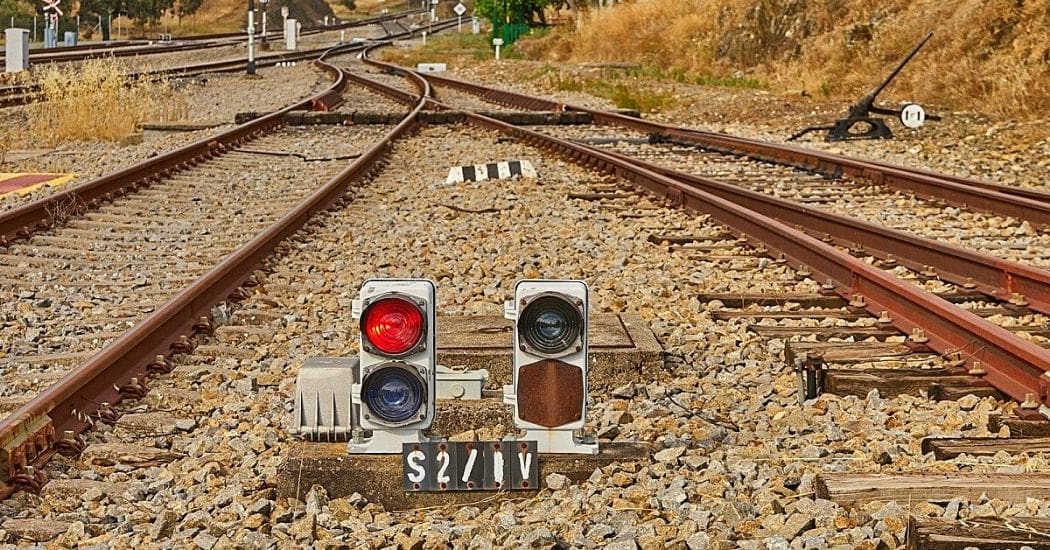
Rail systems, by their very nature, seem like very inflexible modes of transportation, but the reality is that there are a number of elements, mechanisms, and systems, which make railroads and trains one of the primary modes of transportation even today. One of these mechanisms is the railway switches, which allow trains or railcars to branch off, pass other trains, or rejoin a track.
Railway switches are movable components that form part of the track, or rail, along which a train travels; generally, these switches They move between two positions (left or right) to make the train go in one direction or the other. In the past, during the 20th century, these were buildings or small huts that served as “switch houses,” controlling the switches at different sections of the track while also protecting the switches from the weather.
How does a switch or turnout work?
Needle changes are usually performed using a three-part mechanism, beginning with a first section called change, followed by a intermediate zone and ending at the intersection.
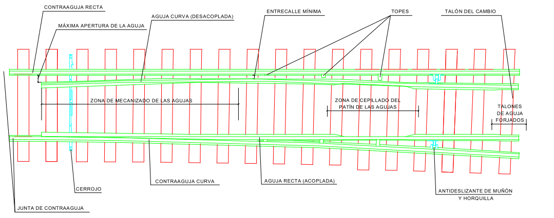 Track switching diagram. Source: masqueingenieria.com
The Change
This is the starting point of the detour, and it consists of needles and counter-needles. The needle is a moving part at its end farthest from the crossing, called the heel, while the counter-needle is a completely fixed part that is positioned on the outside of the needle. Both are coupled and connected via drive elements that are responsible for carrying out the detour in circulation.
Intersection
An intersection is the point where a lane change takes effect; it consists of Two counter-rails and a heart. The center of the crossing is responsible for blocking one of the tracks on the crossing with the track on the opposite side of the diverging track, while, on the other hand, the guardrails prevent any derailment as the train passes through the heart.
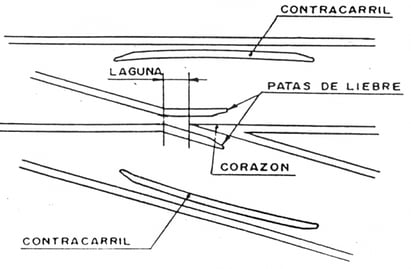 Track-crossing diagram. Source: masqueingenieria.com
Types of Needle Exchanges
- Simple Detour: This is the most common and simplest method; it involves splitting the guide into two branches to form a ”Y” shape, with one of the branches remaining straight.
- Double detour: Following the same principle as a simple turnout, this type is used when space is limited and the track does not allow for multiple consecutive turnouts. It consists of a track split from which two other tracks branch off, creating a trident shape.
- Double-Junction Crosspiece: Crossings are “X“-shaped crossing devices. They allow you to enter at one end and exit through either of the other two ends opposite it.
- Simple Connecting Crossbar: This one retains the same “X“ shape, but only allows the train to change tracks in one of the two directions. In other words, if the train enters at the lower left corner, it can only continue on the same track.
- Exhaust: It consists of two consecutive, simple turnouts facing each other and is used to connect two parallel tracks.
- Changing circular needles: It is a type of needle-changing mechanism that features a spring which allows the needles to move and return to their original position. This is to prevent them from breaking in case the change is not performed correctly.
- Shoulder strap: These are two interlocking switch points located between two parallel tracks.
- Diagonal: It is used to divert trains onto several parallel tracks; it consists of a diagonal switch that passes through several consecutive tracks, allowing the train to access any of them.
We can see how an action that seems as simple as changing a train lane, which It's done through a system that's so simple, can lead to such a wide variety of approaches and methods. Railroad switches are not only a very practical solution, but one that can be adapted to the various situations and challenges arising from a transportation system that appears rigid; but which It becomes flexible thanks to a pair of moving needles.