
What You Didn't Know About This Interesting Structural Principle Known as tensegrity, thanks to Buckminster Fuller.
Tensegrity and the Benefits of Structural Tension
Engineering has evolved significantly over the years and has made it possible to design and build increasingly innovative and complex structures. One of the most interesting ideas to emerge in this field is the concept of tensegrity, a technique that has revolutionized the design and construction of lightweight, strong structures.
Tensegrity is based on the balance between tensile and compressive forces, and its application in structural design has made it possible to create surprising and highly functional forms. In this article, we will delve into the concept of tensegrity, its origins, and its most notable applications in architecture and engineering.
Buckminster Fuller and Tensegrity
Tensegrity has its origins in the studies of the famous architect Buckminster Fuller, who in the 1940s and 1950s began experimenting with lightweight structures and durable, based on the balance between tensile and compressive forces. Fuller sought to create structures that could better withstand external loads and forces without having to rely on heavy and expensive materials.
For Fuller, tensegrity was a way of applying the natural principles of geometry and physics in the creation of efficient and sustainable structures. His tensegrity designs include such iconic structures as the the United States Pavilion at the 1967 Montreal World's Fair and the Geodesic Dome, a spherical tensegrity structure that has become an icon of modern architecture. Tensegrity has continued to evolve at the hands of modern engineers and architects, who have created new and surprising structures using this revolutionary technique.
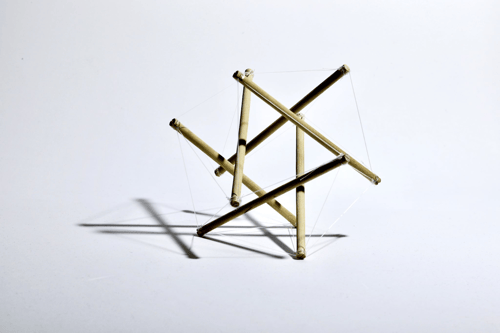
Scale model of a self-supporting structure based on the principle of tensegrity. MyModernMet
How does tensegrity work?
To understand how tensegrity works from a geometric and physical standpoint, we can start by imagining a structure made up of rods and ropes interconnected with one another. In a tensegrity structure, The strings are under constant tension. which is distributed throughout the structure, while The rods are compressed due to the action of the strings.
In tensegrity, the tensile and compressive forces, act in opposite directions but complement each other to maintain the stability of the structure. The cables are tensioned to keep the rods compressed, while the compressed rods keep the cables taut, resulting in a structure self-supporting and sturdy.
From a physical standpoint, tensegrity is based on the principle of force distribution. In a tensegrity structure, external forces are distributed throughout the structure via the cables, which reduces the concentration of efforts at specific points and increases the strength of the structure as a whole.
Some examples based on tensegrity
1. Underwood Pavilion
Pavilion designed and built at the Ball State University, with a structure consisting of 56 modules using a 3-point tensegrity structure to support them against each other. It relies on parametric design to fit the solid and void elements together in a way that creates a curved shape of the modular pavilion and to be able to frame some views of the surroundings from within it.
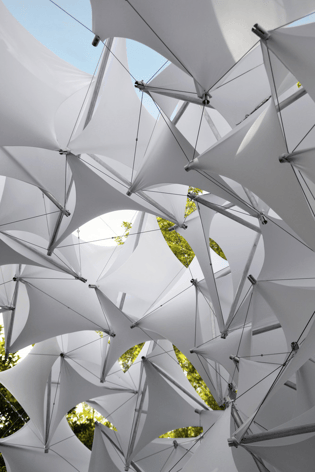
Photo taken from inside the Underwood Pavilion. Source: Archdaily
2. White Rhino II
It is a structure designed by university professors Imai and Kenichi Kawaguchi, who developed a method that eliminates distortion, using stretchable materials and a system that allows to tighten the structure using only the strength of one or two people. It is a central pillar constructed using the techniques we mentioned earlier, which supports the canvas roof of the entire pavilion.
3. Kurilpa Bridge
This is a pedestrian bridge located in the business district of the city of Queensland, Australia, that connects to the new arts district. In this case, tensegrity is not the basis of the bridge’s support structure, since this It functions like a standard beam bridge but it has a structure of masts at the top that makes the canopy appear to float without any supports, and that these structures remain rigid thanks to the principle of tensegrity.
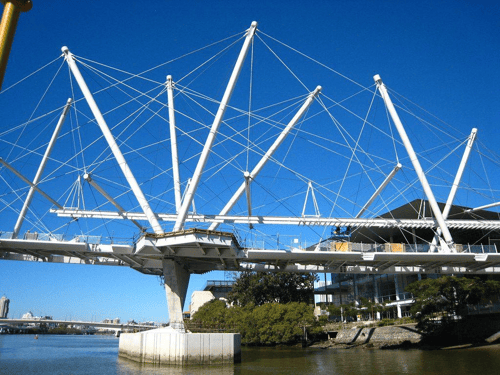
Photo of the Kurilpa Bridge in Australia. ISUU – Uberli Cieza
The application of tensegrity in architecture and engineering has led to the creation of striking and highly functional forms, and understanding it is essential for innovating and creating efficient structures that are also aesthetically appealing. If you’re interested in learning more about efficient structures, we invite you to explore the Master’s program in Structural Analysis by Structuralia, where you'll be guided by experts in this field.