There are several Types of connecting rods based on their shape and characteristics, Find out what its functions are.
Types of Connecting Rods and Their Applications in Industry
In the fascinating world of mechanical engineering, there are essential components that often go unnoticed, but which play a crucial role in the functioning of various mechanisms. One such element is the connecting rod, a piece of engineering that plays a vital role in countless applications and devices in our daily lives. In this post, we'll take a closer look at the various Types of Connecting Rods and highlighting its importance in today's industrial landscape.
In this article, we’ll explore the different types of connecting rods and highlight their importance in today’s industrial landscape. Just like other major technological innovations, such as the FAST radio telescope, the world's largest, the connecting rods are an example of how engineering transforms complex challenges into practical solutions that have an impact across multiple sectors.
What is a connecting rod?
A connecting rod is a bar or rod that connects two moving points in a mechanism. It consists of a known end as a cylinder head or connecting rod head, which is attached to the primary moving point, and an end called foot or connecting rod, which connects to the secondary pivot point. The connecting rod acts as a crucial link between these two points, allowing for the transfer of force and motion.
How does a connecting rod work?
The basic operation of a connecting rod is based on the principle of the lever. When a force is applied to the head of the connecting rod, it is transmitted through the rod and results in rotational movement at the joint where the connecting rod meets the crankshaft. The length and geometry of the connecting rod are key factors that affect the mechanism's performance and efficiency. In addition, it is important to note that the connecting rod's motion is typically oscillating, converting linear motion into rotational motion and vice versa.
In internal combustion engines, such as automobile engines, The connecting rod plays a crucial role in converting the piston's linear motion into a rotational motion needed to drive the crankshaft. The piston is attached to the end of the connecting rod by a connection known as wrist or stump. As the piston moves up and down inside the cylinder, the connecting rod transmits this motion to the crankshaft journal, thereby generating the rotational motion that drives the engine. Without the connecting rods, the transfer of motion between the engine's components would be virtually impossible.
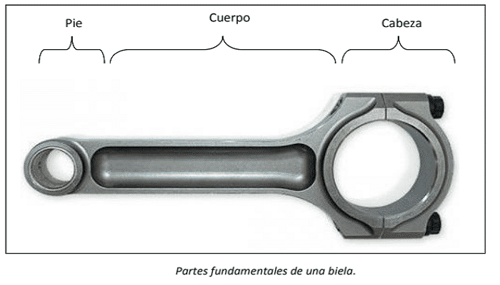
A single connecting rod and its main parts. Mundodelmotor.net
Types of Connecting Rods Based on Their Shape
1. Single-joint connecting rod
This is the most basic and common type of connecting rod. It consists of a a straight rod connecting the head and the foot of the connecting rod at a simple joint. This design is used in applications where the linear motion of the primary point is converted into rotational motion at the secondary point, such as in four-stroke internal combustion engines. The single-joint connecting rod is essential for converting the piston's reciprocating motion into the crankshaft's rotational motion.
2. H-shaped link rod
This type of connecting rod is characterized by an inverted «H»-shaped cross-section. Here, Two rods connect to a central head and join at a single connecting rod. The H-shaped link is used in applications that require greater strength and rigidity, such as in high-powered engines and large diesel engines. This configuration allows for even load distribution and minimizes the possibility of deformation or fails under extreme loads.
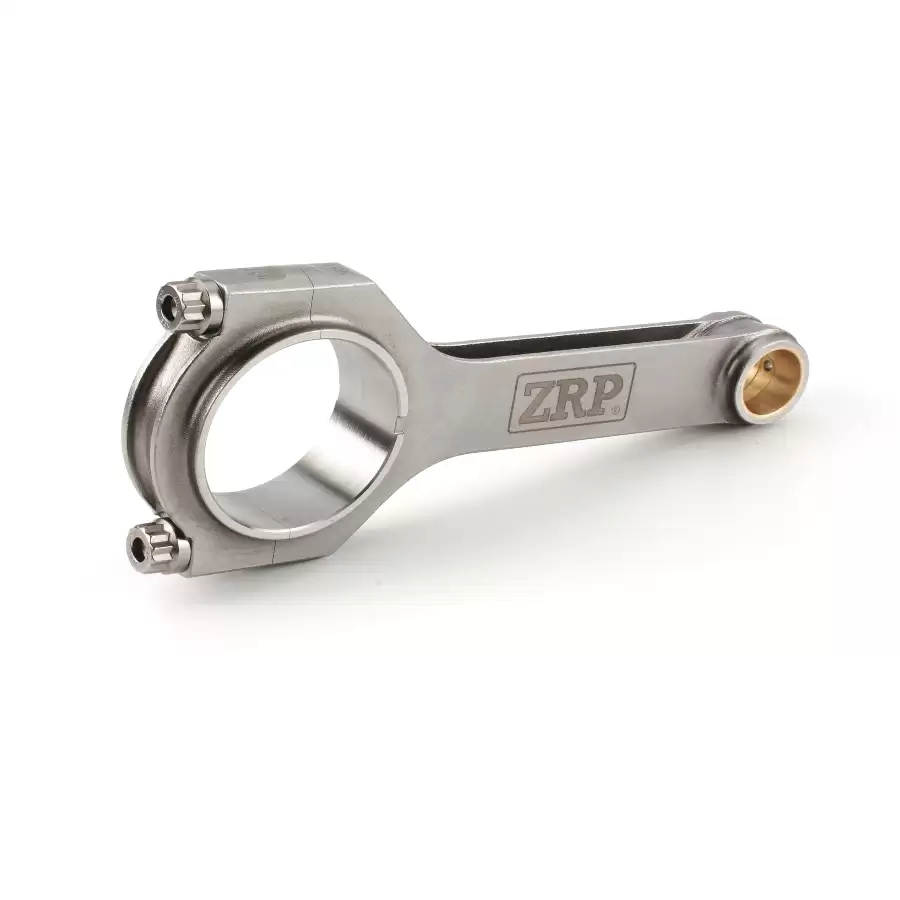
“H”-type forged steel connecting rod. Rstmotorsports.com
Types of Connecting Rods Based on Their Characteristics
In addition to the types of connecting rods mentioned above, there are other classifications based on specific design and operational characteristics. Below, we explore four additional types of connecting rods:
1. Oil Drip Rod
This connecting rod variant features an internal lubrication system to ensure a constant supply of oil to key friction points. The oil-drip connecting rod uses an internal channel or a hole in the connecting rod to allow oil to flow to the main and head bearings. This helps reduce friction and wear, thereby improving the durability and performance of the connecting rod. These cranks are commonly found in High-Performance Motors and Industrial Applications that require smooth operation and a long service life.
2. Articulated Connecting Rod
This type of connecting rod has a more complex joint design compared to a simple joint. The articulated connecting rod consists of several elements that are connected in an articulated structure, which provides greater flexibility and adjustability. This configuration allows greater adaptability to variations in load conditions and vibrations, resulting in greater fatigue resistance and a longer service life. Articulated connecting rods are used in applications that require greater precision and strength, such as aircraft engines and heavy machinery.
3. Fork and Knife Handle
This type of connecting rod gets its name from its distinctive shape, which is It looks like a fork and a knife. The fork-and-knife connecting rod is characterized by having two separate pieces at the head end of the connecting rod, which fit together as a single piece at the foot end of the connecting rod. This configuration It allows for a better balance of forces and greater resistance to lateral loads. These cranks are used in high-performance engines and applications where precision and durability are essential.
4. Sliding-joint connecting rod or crank-connecting rod
In this type of connecting rod, the foot end slides along a curved surface rather than being directly hinged. This configuration It allows for greater efficiency in power transmission and reduces friction, which is beneficial in applications that require smooth and precise motion. The sliding-joint connecting rods They are commonly used in machine tools, presses, and other mechanisms such as those that power the locomotives where the goal is to minimize wear and friction.
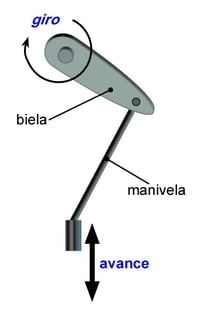
A schematic example of a type of connecting rod-crank mechanism. Galician Regional Government
Conclusion
Cranks are an important component in the mechanical engineering, found in engines, compressors, locomotives, and industrial machinery. Its design, just as with structural solutions such as the Drainage on flat roofs, meets the need for efficiency, durability, and safety in every application,
Understanding the different Types of Connecting Rods and Their Applications It allows us to appreciate the diversity of solutions that engineering has developed to optimize the performance of the mechanical systems that support our daily lives.