Originally published on December 3, 2024; updated on August 26, 2025
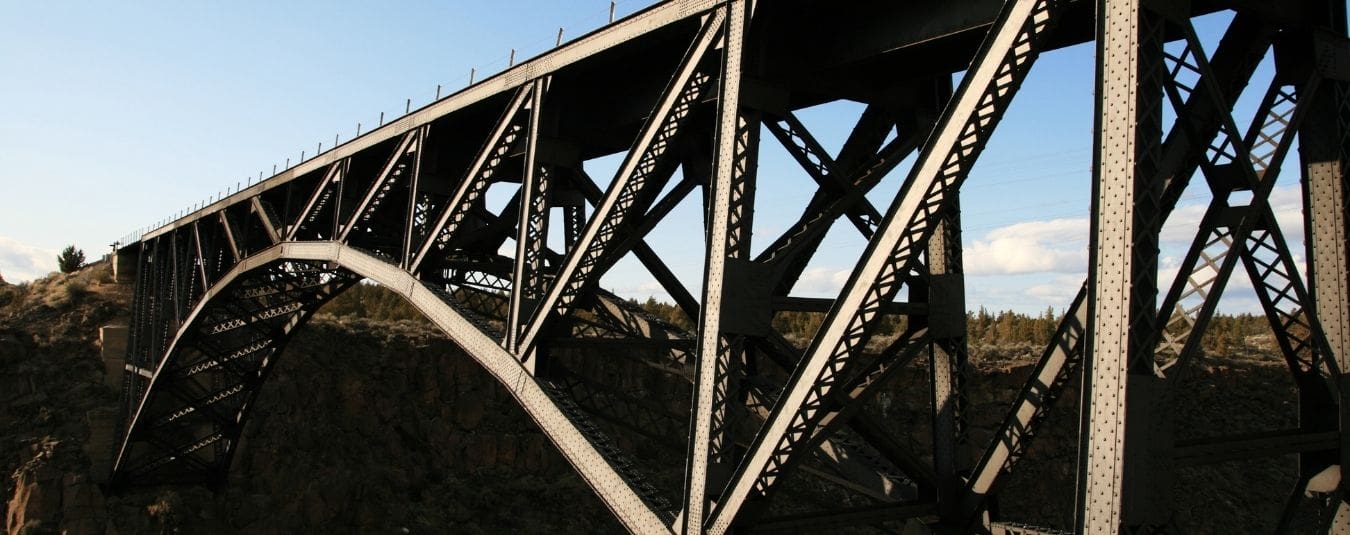
You've probably seen a triangular wooden roof or a large steel bridge supported by crisscrossing beams at some point. These structures are known as trusses, and they are essential in construction because they make it possible to build roofs, industrial buildings, towers, or bridges that are sturdy and require less material than you might imagine

What is a truss?
One truss It is a structural element consisting of a set of straight members joined at their ends by hinged joints. Generally, these members form triangles, making the truss a very stable and strong system for spanning large clear spans without the need for intermediate supports.
Trusses are primarily used in roofs, bridges, towers, hangars, and silos, and can be made from various materials such as wood or steel. For example, wooden trusses are very common in traditional roofs and sustainable architecture, while steel trusses are commonly used in industrial buildings and bridges due to their high load-bearing capacity.
The Origin of the Truss
There is evidence of the use of [...], dating back to the year 1500. composite structural elements based on triangles in buildings throughout Europe, and in the mid-18th century, they began to be mass-produced for civilian construction. The triangle is the simplest form of a truss, it is used repeatedly to form the structural element and thus span the required distance. To be considered a truss, The element must consist of several triangles, consisting of three beams each, and with three joints.
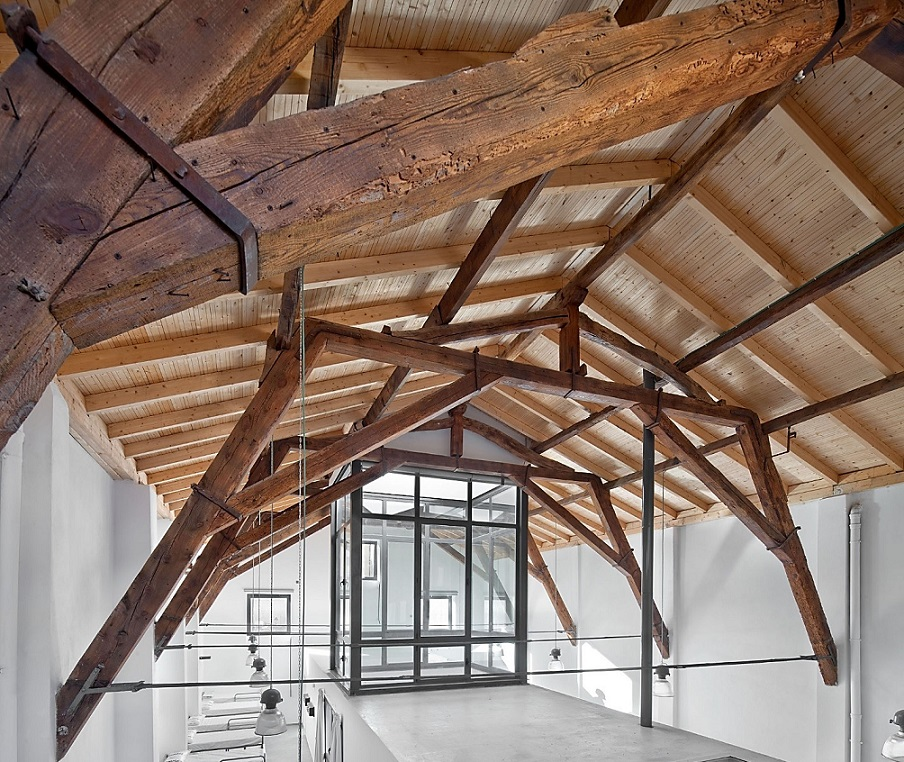
Santiago Apostol Hostel Source:Sergio Rojo, architect.
Parts of a truss
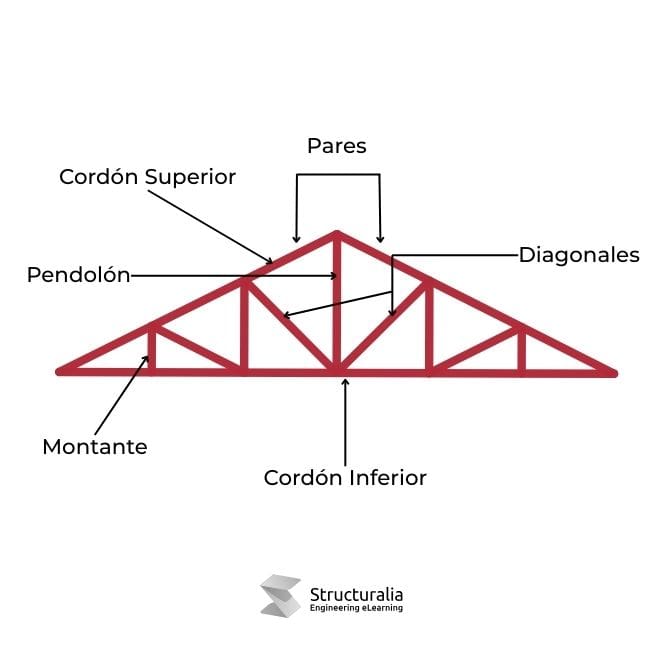
To better understand how it works, it is helpful to know the main parts of a truss:
- Upper Lace: top chord of the truss, subjected to compression.
- Bottom cord: lower chord of the truss, subjected to tension.
- Stiles: vertical bars that transfer loads between strands.
- Diagonals: inclined bars that stabilize the structure and distribute forces.
- Pendolón: joints between the bars, usually hinged.
Types of Trusses
As we mentioned earlier, there can be an infinite number of types of trusses. In fact, the appearance of a truss cannot be defined beyond the geometric use of the triangle. The design of a truss is determined by its intended use, we can see it in buildings, towers, bridges, silos, roofs, latticework, tensile structures, etc. Even so, we'll try to make a A brief overview of the most well-known types, and sort them by category:
1. Based on their composition
- Simple: It is a statically determinate truss; the number of members and joints must satisfy the established formula. That is why it has the familiar triangular shape.
- Composed: Like the simple truss, it is statically determinate but is designed using one or two simple trusses. Both structures must be connected to keep them in place, and may include additional members or a frame.
- Complex: It is a hyperstatic truss, a type of truss that includes the two previous types and even several geometric configurations beyond the triangle.
2. Specific trusses
- Long Truss: designed so that the upper and lower horizontal chords are connected by vertical members, and braced by double X-shaped diagonals.
- Howe truss: also known as a Belgian truss, it resembles the previous type in that it uses vertical members between the top and bottom chords, but in this case, diagonal steel members are used. Commonly used in wood construction.
- Pratt truss: made entirely of steel, it differs from the Howe truss only in that its diagonal members form a V.
- Warren truss: This structural element is characterized by being composed of isosceles equilateral triangles, since all sides are of equal length. Compressive and tensile forces occur in the cross-braced members due to the loads applied at the upper joints.
- Truss K: widely used in the design of bridges, and visually it is defined by a vertical element with two diagonal elements extending from its center.
- Baltimore truss: Also used in bridges, this series features additional support at the bottom of the structure, and its sections resemble three triangles nested within one another, all extending from a horizontal beam.
Trusses are undoubtedly a very versatile structural and construction element, still indispensable in civil engineering today after more than 500 years. To explore design and structural analysis in greater depth, as well as the different types of trusses that exist, we invite you to check out the program for the Master's Degree in Structural Analysis on Structuralia.